Mining Screen Mesh Quality Control: A Buyer's Guide to Inspection Standards & QC Checklist
Mining Screen Mesh Quality Control: A Buyer's Guide to Inspection Standards & QC Checklist
If you're purchasing 65Mn woven wire screen mesh for your mining or quarrying operation, you already know that not all screen mesh is created equal. But how do you verify quality before the mesh arrives at your site — or worse, before it fails prematurely on your vibrating screen?
This guide covers the quality control system behind 65Mn mining screen mesh: the applicable standards, key inspection parameters, accuracy grades, sampling procedures, and a practical checklist you can use when evaluating suppliers.
The Standards Framework for Mining Screen Mesh
Mining screen mesh quality is governed by a hierarchy of international and Chinese national standards. Understanding which standards apply helps you specify the right product and verify compliance upon delivery.
| Standard | Scope | Key Role |
|---|---|---|
| GB/T 17492-2019 ≡ ISO 9044:2016 | Industrial woven wire cloth | Defines aperture accuracy grades (S/H/P/UP) and test methods |
| JB/T 9032-2018 | Mining woven screen mesh | Covers dimensions, hook strips, classification codes (BK/CQ/JF/JS) |
| GB/T 5330-2025 | Square hole screen mesh | Specifies R20/R40 aperture series and selection |
| GB/T 1222-2016 | Spring steel — 65Mn grade | Defines chemical composition and mechanical properties |
| GB/T 2828.1 ≡ ISO 2859-1 | Sampling procedures | Establishes AQL-based lot acceptance criteria |
For international buyers: GB/T 17492-2019 is modified equivalent to ISO 9044:2016. Products can be dual-marked (e.g., "GB/T 17492-2019 / ISO 9044:2016") for global acceptance.
Six Key Inspection Parameters
Quality inspection for mining screen mesh covers six critical areas. Each has defined tolerances and test methods.
1. Material Verification (65Mn Steel Grade)
The foundation of screen mesh quality is the raw material itself. 65Mn spring steel must meet the following chemical and mechanical properties per GB/T 1222-2016:
| Parameter | Requirement | Reference |
|---|---|---|
| Carbon (C) | 0.62% – 0.70% | Table 12 |
| Manganese (Mn) | 0.90% – 1.20% | Table 12 |
| Tensile strength | ≥ 980 MPa | Table 25 |
| Yield strength | ≥ 785 MPa | Table 25 |
| Elongation | ≥ 8% | Table 25 |
| Decarburization layer | ≤ 1% of dia, ≤ 0.10mm max | Clause 4.5.1 |
How to verify: Request a Mill Test Certificate (MTC) from the supplier with each shipment. The certificate should show the exact chemical composition and mechanical test results for the wire lot used in your order. A reputable supplier will provide this without hesitation.
2. Wire Diameter Tolerance
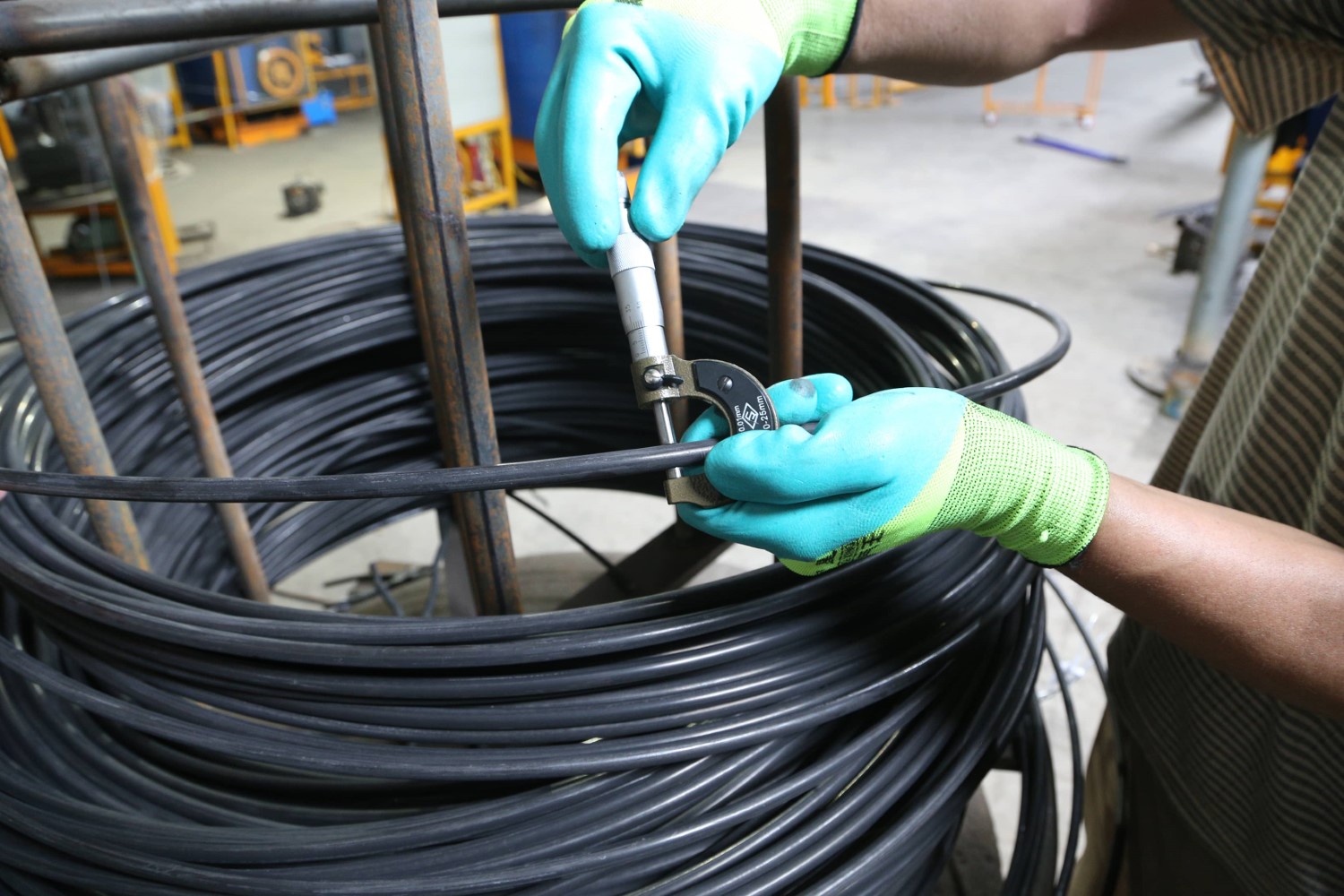
Wire diameter directly affects screen strength, open area, and service life. Per GB/T 342 (h10/h11 grade), the standard tolerance for mining screen mesh wire is:
Acceptance standard: ±0.03 mm
Inspection method: 5 screen panels randomly sampled per batch; measure 1 warp wire and 1 weft wire per panel (10 measurements total)
Pass criteria: ≤ 1 out-of-tolerance reading → batch passes; ≥ 2 failures → batch rejected
Why it matters: An undersized wire reduces screen life by accelerating wear. An oversized wire reduces open area and decreases screening throughput. Consistent wire diameter is the hallmark of quality weaving.
3. Aperture Accuracy (Mesh Opening)
Aperture accuracy is the single most important quality parameter for screening performance. It is governed by GB/T 17492-2019, which defines four accuracy grades:
| Grade | Code | Typical Use | Max Deviation (Single) | Average Deviation |
|---|---|---|---|---|
| Standard | S | General industrial | ±(x + 0.1d) | ±0.3x |
| High | H | Export / high-performance | ±(0.6x + 0.06d) | ±0.18x |
| Precision | P | Laboratory / QC | ±(0.3x + 0.03d) | ±0.09x |
| Ultra Precision | UP | Metrology / test sieves | ±(0.15x + 0.015d) | ±0.045x |
* x = base deviation for the aperture range; d = wire diameter
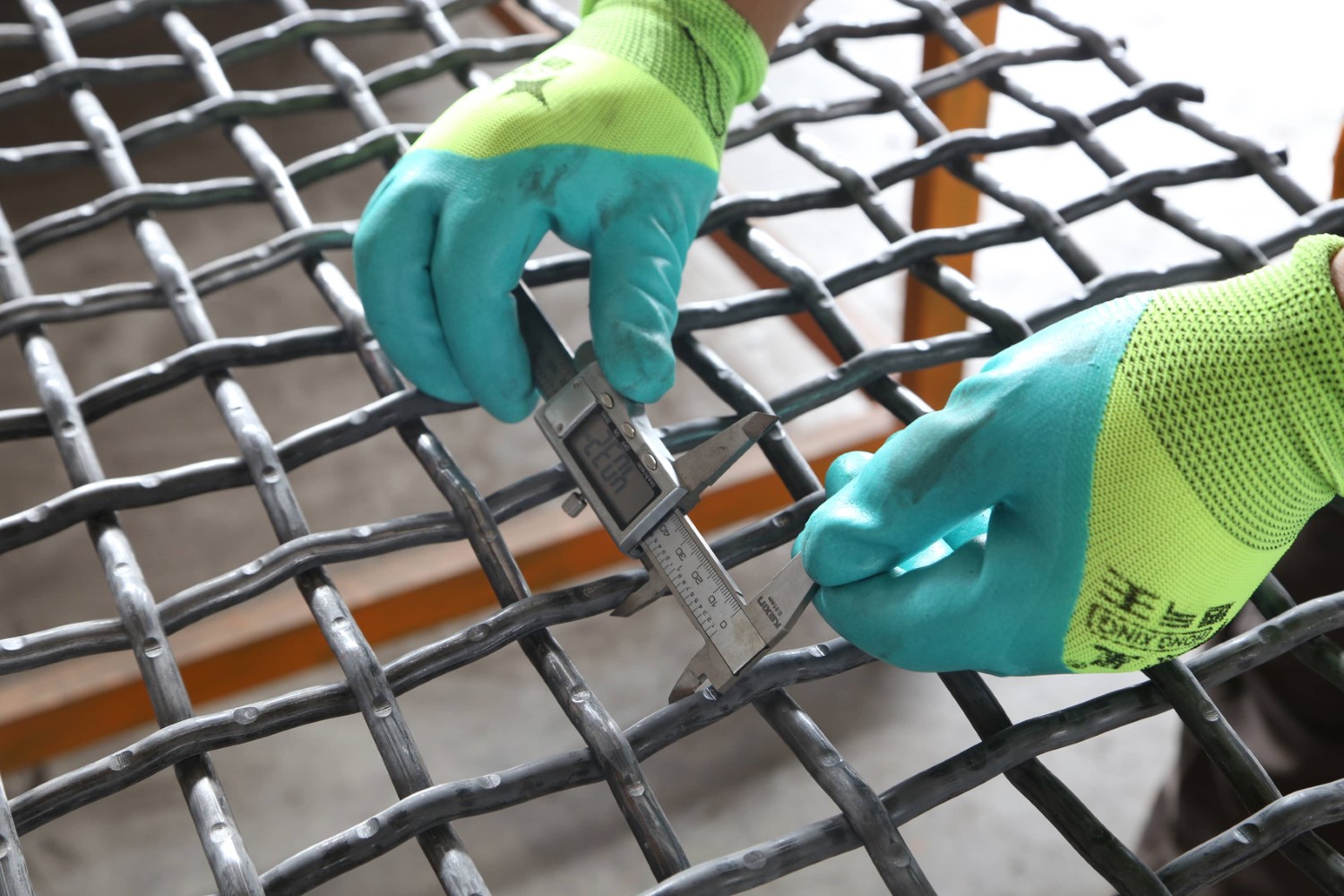
Inspection method: 5 panels sampled; 5 consecutive openings measured per panel, arithmetic mean calculated. The batch passes if ≥ 4 of 5 panels are within ±5% tolerance.
For most mining applications: S-grade is the industry standard. H-grade is recommended for high-precision screening or when the buyer specification requires tighter control.
4. Panel Dimensions
Per JB/T 9032-2018, the dimensional tolerances for finished screen panels are:
| Dimension | Tolerance | Inspection Method |
|---|---|---|
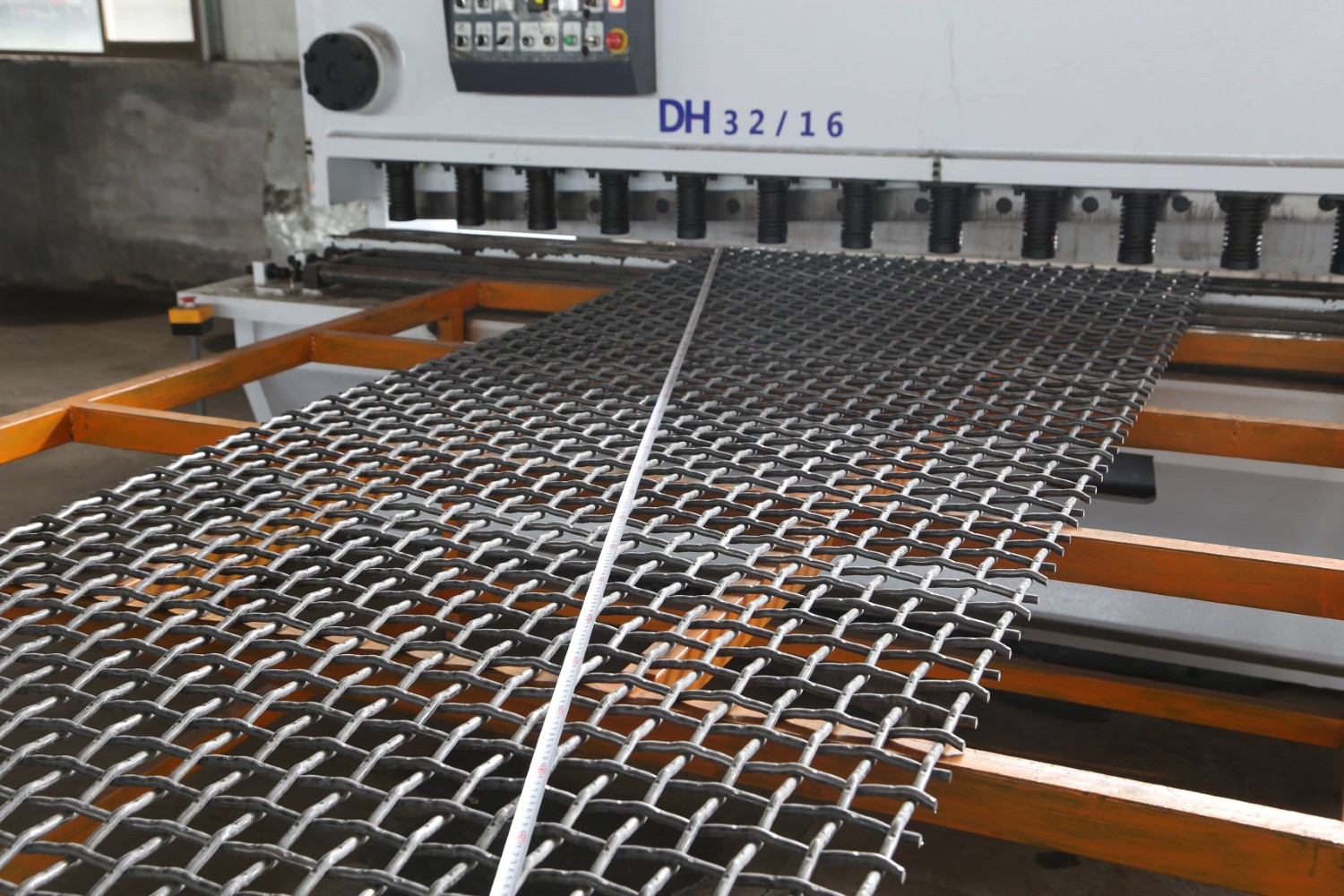
| Width | +30 mm / -10 mm | Steel tape, every panel |
| Length | +50 mm / -20 mm | Steel tape, every panel |
Why the asymmetrical tolerance? The positive allowance (+30/+50) ensures the screen covers the full deck area without gaps. A slightly oversized panel can be trimmed or tensioned into place; an undersized panel can cause material bypass and reduced screening efficiency.
5. Hook Strip Quality
Hook strips are the interface between the screen mesh and the vibrating screen deck. Per JB/T 9032-2018 Appendix A:
| Parameter | Specification | Notes |
|---|---|---|
| Type | C-type (25-60mm) or U-type (15-40mm) | Per order / drawing |
| Thickness | ≥ 1.0mm (wire ≤ 12mm); ≥ 1.5mm (wire > 12mm) | — |
| Quality | Straight, no distortion, no burrs | Visual inspection |
Note: Hook strip issues are one of the most common customer complaints — they must be checked panel by panel before shipment.
6. Appearance
Per JB/T 9032-2018 Clause 6.1, the finished screen must have:
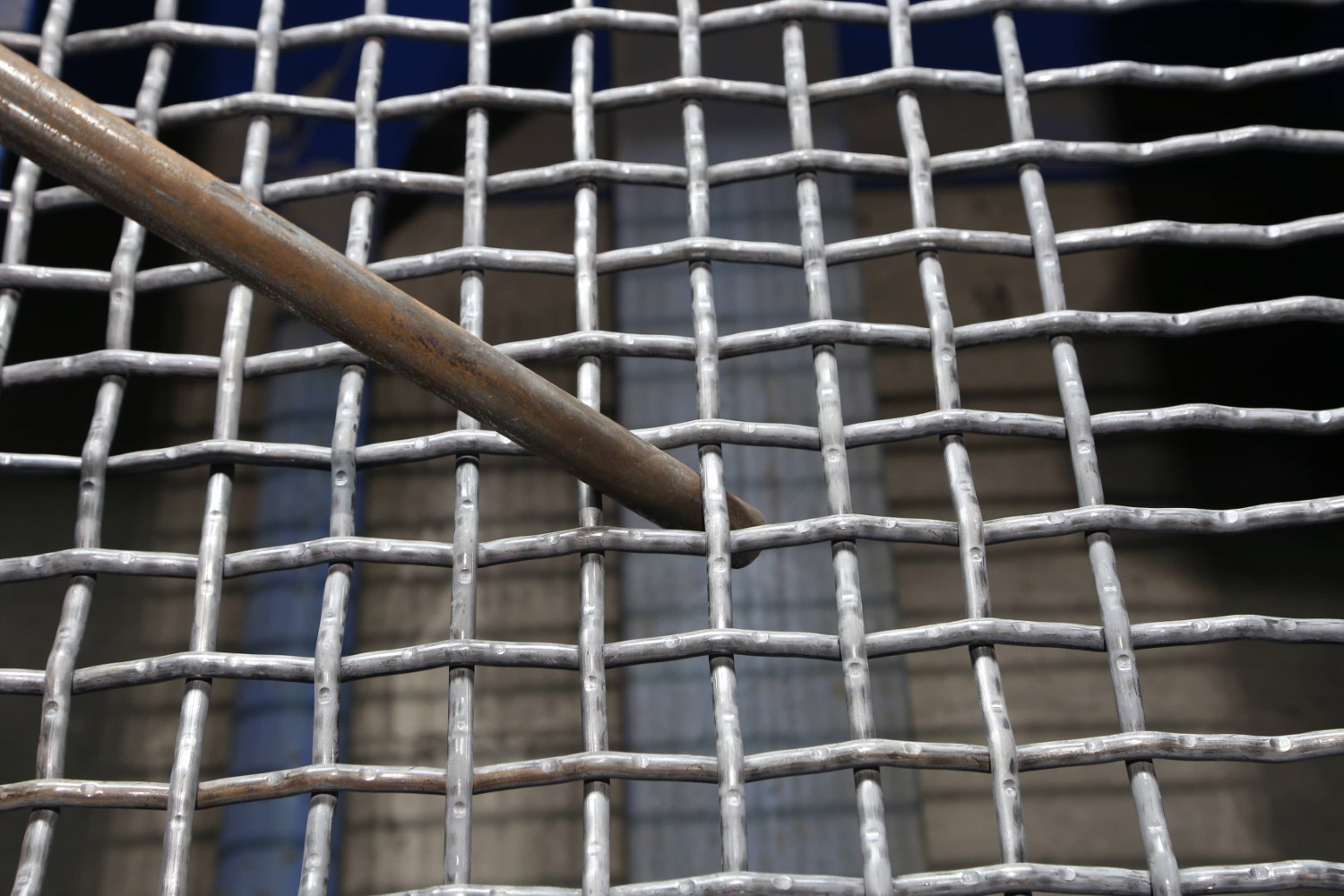
Flat, even surface
Uniform openings across the full area
No broken wires, skipped wires, or fused wires
No rust spots or oil contamination
Inspection method: 100% visual inspection of all panels.
Sampling and Acceptance: The AQL System
Not every panel in a batch can be inspected for every parameter. Instead, suppliers use statistical sampling per GB/T 2828.1 (ISO 2859-1) with the following defect classification:
| Defect Category | Definition | AQL | Action on Failure |
|---|---|---|---|
| Critical | Wrong material, broken wires, 3+ consecutive misaligned openings | 0 | Entire batch rejected; next 3 batches under tightened inspection |
| Major | Wire diameter out, aperture out, dimensions out, hook strip non-conforming | 2.5 | Batch rejected or 100% screening required |
| Minor | Light surface rust (removable), slight oil, packaging damage | 4.0 | Accepted with notation |
What this means for buyers: The AQL 2.5 for major defects means that in a typical shipment, up to 2.5% of panels may have a major defect and the batch would still be statistically acceptable under normal inspection. If you need tighter quality, specify H-grade aperture tolerance and request special inspection level S-3 or S-4 (per GB/T 2828.1).
Supplier Quality Checklist
Use this checklist when evaluating or auditing a mining screen mesh supplier:
| # | Check Item | What to Look For |
|---|---|---|
| 1 | Material traceability | Do they provide mill certificates for each wire lot? |
| 2 | In-house weaving | Do they weave in-house or resell from third parties? |
| 3 | Wire diameter gauge | Are digital micrometers calibrated and in use? |
| 4 | Aperture measurement | Do they use optical projectors or calibrated gauges? |
| 5 | Sampling plan | Do they follow a documented AQL-based sampling plan? |
| 6 | Hook strip checks | Are all panels checked for hook strip straightness? |
| 7 | Packaging standard | Are panels bundled with edge protection for container loading? |
| 8 | Inspection report | Do they offer final inspection photos before shipment? |
| 9 | Third-party inspection | Do they accept SGS, Bureau Veritas, etc.? |
| 10 | Standard compliance | Do they reference specific standard numbers in quotations? |
Common Quality Issues in Mining Screen Mesh
Issue 1: Wire Diameter Variation
Wire that varies in diameter within the same panel creates uneven stress distribution. Thin sections wear faster; thick sections reduce open area. The result: unpredictable screen life and inconsistent sizing.
Prevention: Specify ±0.03mm wire tolerance in your purchase order. Request the supplier's wire gauge control records.
Issue 2: Aperture Drift
Over the width of a large screen panel, the aperture may gradually widen or narrow due to uneven tension during weaving. This causes material to pass through where openings are oversized and block where they are undersized.
Prevention: Require H-grade aperture tolerance for high-precision applications. The cost premium is modest compared to the improvement in screening accuracy.
Issue 3: Hook Strip Deformation
Bent or twisted hook strips prevent proper mounting on the vibrating screen deck. The screen may not tension evenly, leading to premature failure at the edges.
Prevention: Insist on 100% hook strip inspection before packaging. This is a simple visual check that catches most issues.
Issue 4: Packaging Damage
Screen panels are heavy and abrasive to each other. Without proper edge protection and secure bundling, edges can be damaged during container loading and transit.
Prevention: Specify packaging requirements in your order — edge protectors, steel strapping, and moisture barrier for sea freight.
About Hangzhou Vertical Cross Metals Co., Ltd.
At Hangzhou Vertical Cross Metals, quality control is documented at every stage of production for our 65Mn mining screen mesh. Our inspection process follows the GB/T 17492 / JB/T 9032 framework with AQL-based sampling per GB/T 2828.1.
Every order includes:
Material traceability — Mill certificates for incoming wire
In-process checks — Wire diameter, aperture consistency, weave quality
Final inspection — Panel dimensions, hook strip quality, packaging integrity
Inspection photos — Available upon request before shipment
Planning a screen mesh order? Contact us with your material type, target aperture size, screen dimensions, and hook strip type — we'll confirm the specification and provide a factory-direct quote with full quality documentation.
First published on — News & Articles