
PU Screening Panel
Long Service Life: 3-5x longer than steel screening media
Non-Blinding: Tapered hole design + elastic self-cleaning prevents pegging
Noise Reduction: Up to 9 dB quieter than steel screens (~50% noise reduction)
Lightweight: Reduces vibrating screen load and energy consumption
Corrosion Resistant: Resists acids, alkalis, water and oil
Modular Quick-Change: Fast deck conversion, reduced downtime
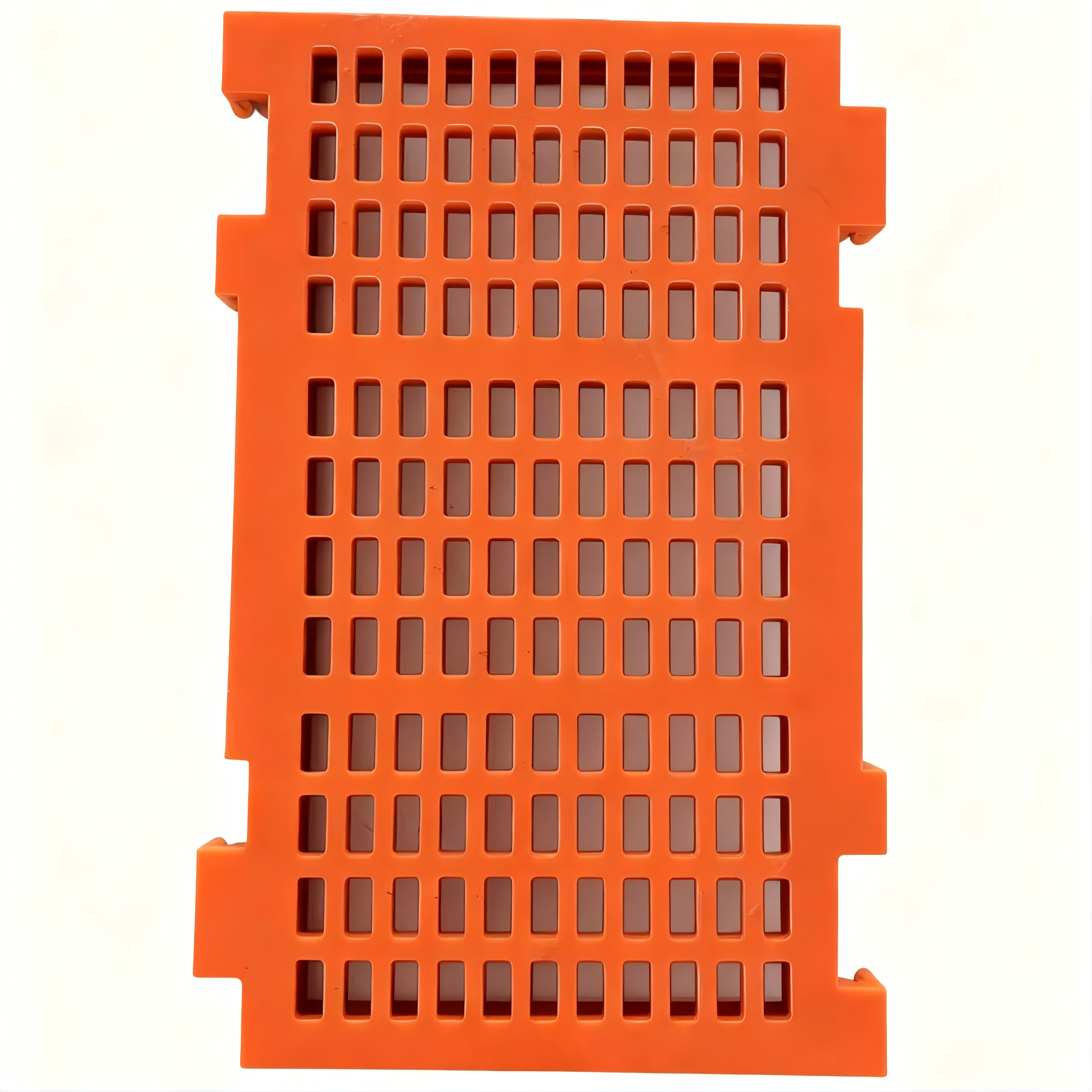
Efficient Dewatering: Slotted panels provide superior dewatering performance
Standards: Meets GB/T 33091-2016 Polyurethane Sieve Plate standard
PU Screening Panel — Product Specifications
Factory-direct PU screening panel per GB/T 33091-2016 for mining vibrating screens. Modular panels 300×1000mm, holes 0.1-120mm. 3-5x longer wear life than steel. Self-cleaning, noise reducing. CE, ISO certified.
Product Name
PU Screening Panel / Polyurethane Sieve Plate
Aliases: PU screen mesh, polyurethane sieve plate, PU modular screen panel
Standards Referenced
| Standard | Title | Application |
|---|---|---|
| GB/T 17492-2019 | Industrial woven wire cloth — Technical requirements and inspection | Core standard: all woven screens, aperture tolerances, weave types, test methods |
| GB/T 5330-2025 | Industrial woven wire square mesh | Aperture R20/R40 series for fine screens ≤16mm |
| GB/T 33091-2016 | Polyurethane sieve plate | PU screen: Shore A hardness, tensile/tear strength, relative volume wear |
| GB/T 6003.1-2022 | Test sieves — Metal wire cloth | Distinguishes UP/P grade from S/H grade |
| ISO 9044:2016 | Industrial woven wire cloth (International) | International base for GB/T 17492-2019 |
Specifications
Aperture Range
| Classification | Aperture Range | Application |
|---|---|---|
| Fine | 0.5 – 5 mm | Fine sand classification |
| Medium | 5 – 30 mm | Sand and gravel separation |
| Coarse | 30 – 100 mm | Quarry primary crushing |
| Extra Coarse | 100 – 150 mm | Extra-large lump separation |
| Slotted | 0.5 – 50 mm (width) | Dewatering / wet screening |
Standard Module Dimensions
| Module Type | Dimensions (mm) | Thickness |
|---|---|---|
| Center Module | 300 × 1000 | 30–60 mm |
| Standard Module | 300 × 600 | 30–50 mm |
| Standard Module | 300 × 1220 | 30–50 mm |
| Standard Module | 610 × 610 | 30–50 mm |
| Fine Screen Panel | 1045 × 700, 840 × 1245 | 25–40 mm |
| Custom Length | Up to 3600 mm | 30–75 mm |
Tensioned Screen Panel
| Parameter | Range |
|---|---|
| Panel Size | 1200 × 1800 mm (standard), custom available |
| Max Width | 3000 mm |
| Edge Type | 45° hook strip, metal or PU encapsulated |
Hole Shape
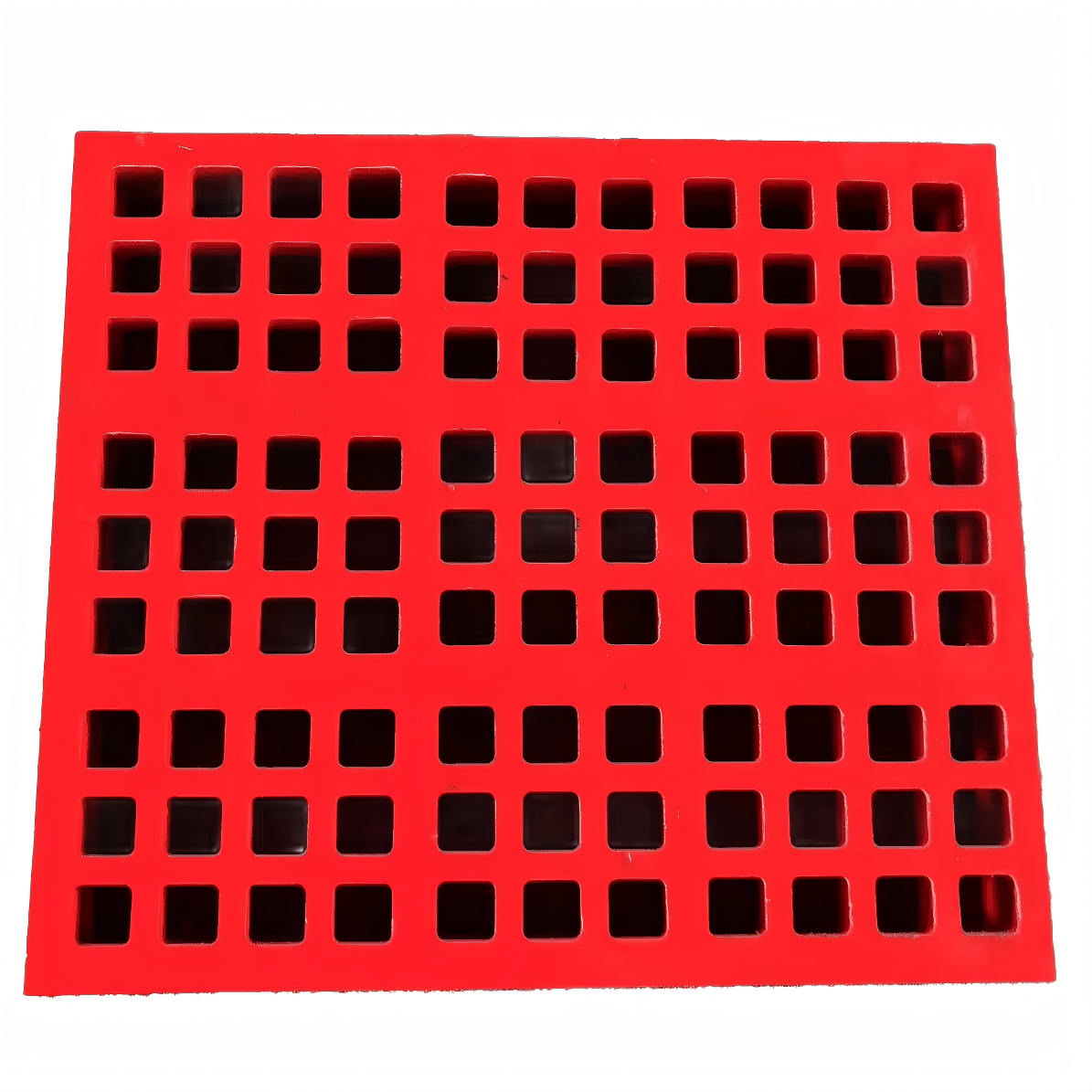
Square — general classification
Slotted / Bar Seam — dewatering, wet screening
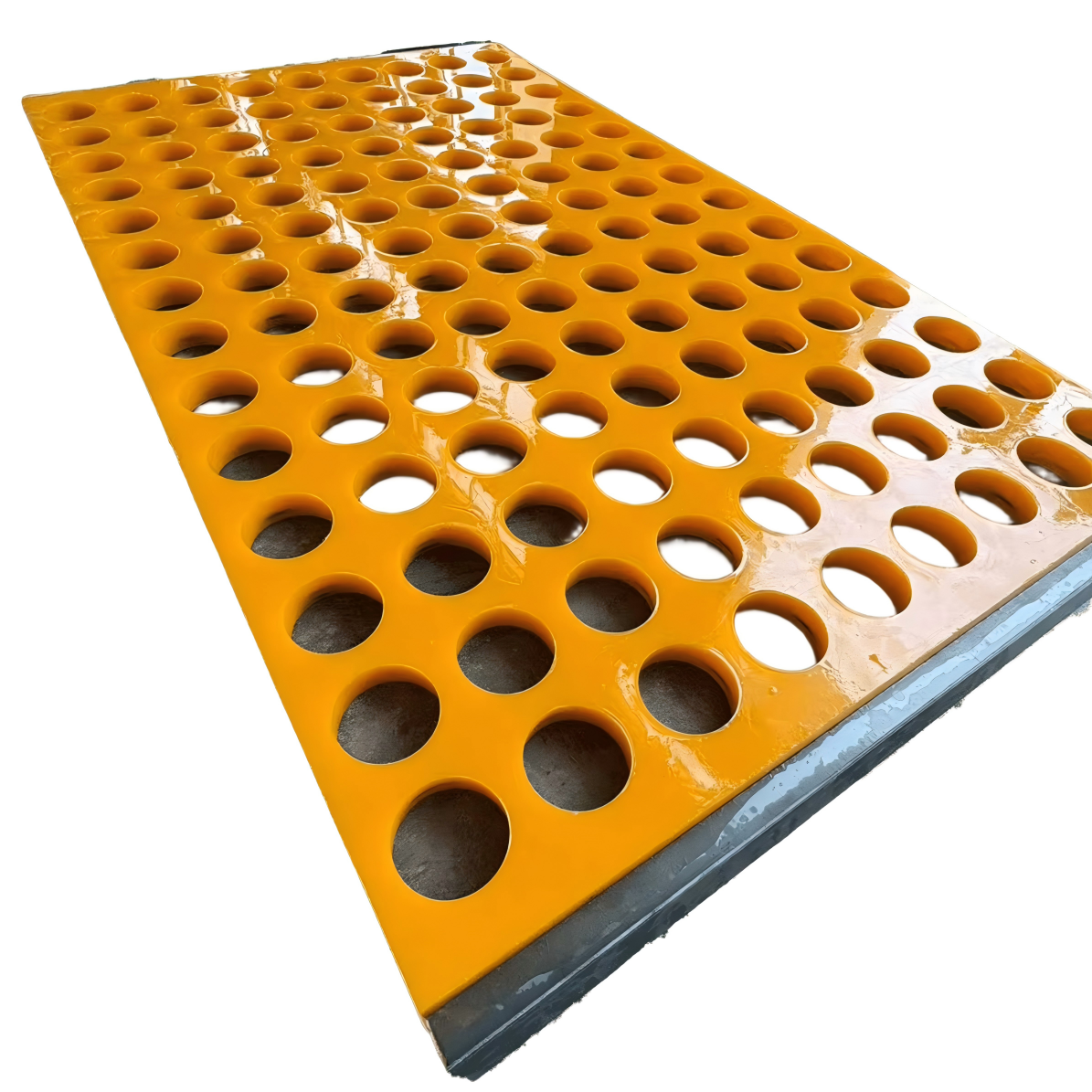
Round — specific particle shape requirements
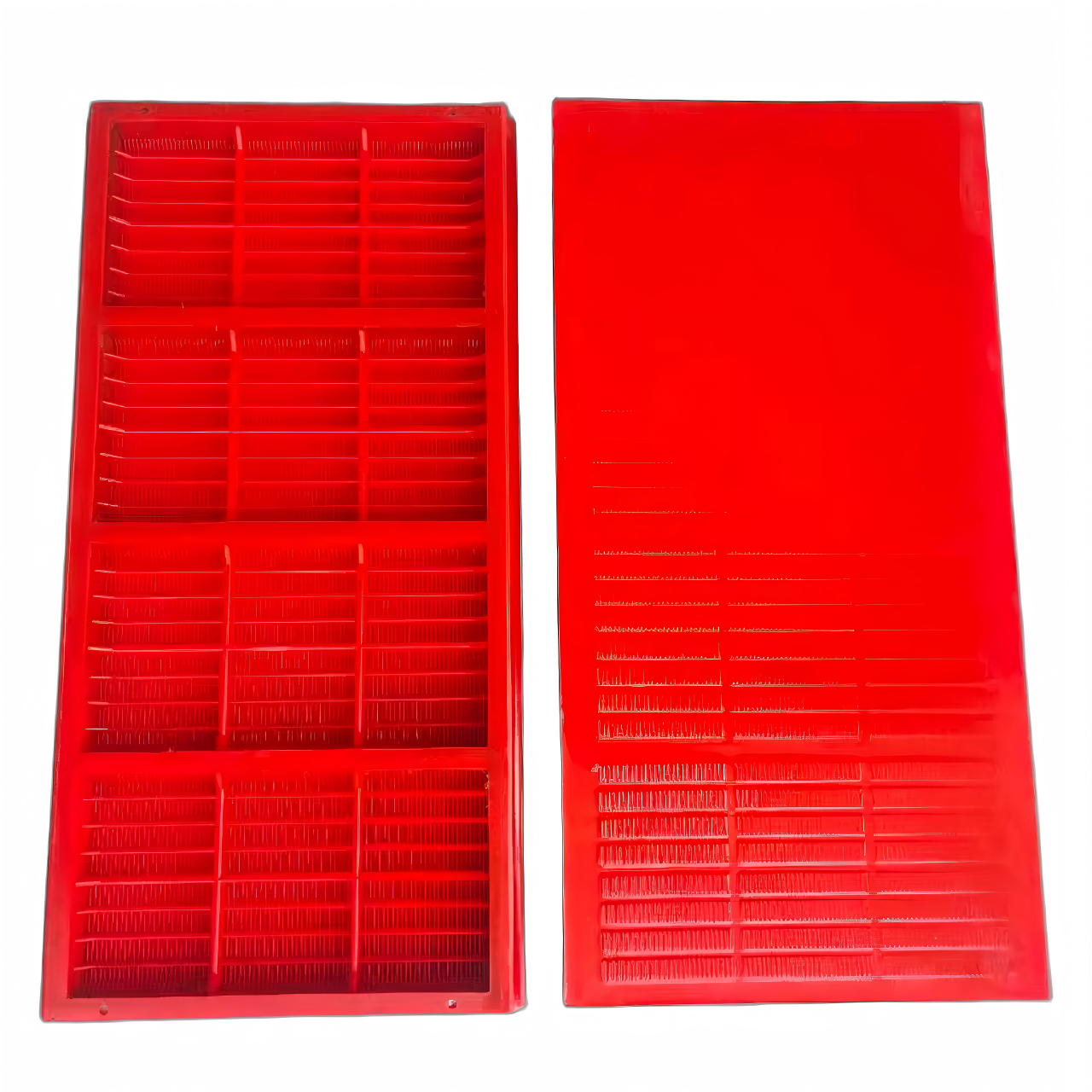
Continuous Grooves — ultra-fine screening
Polyurethane Material Properties (Per GB/T 33091-2016)
| Property | Polyester Grade | Polyether Grade |
|---|---|---|
| Hardness (Shore A) | 80±2 / 85±2 / 90±2 / 95±2 | 90±2 / 95±2 |
| Tensile Strength | ≥ 40–48 MPa | ≥ 30–40 MPa |
| Elongation at Break | ≥ 500–600% | ≥ 300–400% |
| Tear Strength | ≥ 70–100 kN/m | ≥ 75–90 kN/m |
| Rebound Resilience | ≥ 25% | ≥ 35% |
| Relative Volume Wear | ≤ 60 mm³ | ≤ 40 mm³ |
Polyether: Better rebound and abrasion resistance — recommended for wet screening and washing applications
Polyester: Higher tensile and tear strength — recommended for heavy-load dry screening
Product Highlights
| Highlight | Description |
|---|---|
| Long Service Life | 3-5x longer than steel screening media |
| Non-Blinding | Tapered hole design + elastic self-cleaning prevents pegging |
| Noise Reduction | Up to 9 dB quieter than steel screens (~50% noise reduction) |
| Lightweight | Reduces vibrating screen load and energy consumption |
| Corrosion Resistant | Resists acids, alkalis, water and oil |
| Modular Quick-Change | Fast deck conversion, reduced downtime |
| Efficient Dewatering | Slotted panels provide superior dewatering performance |
| Standards | Meets GB/T 33091-2016 Polyurethane Sieve Plate standard |
Detailed Product Description
PU (polyurethane) screening panels are high-performance screening media per GB/T 33091-2016 for mining, quarrying, coal washing and sand processing. Unlike woven steel mesh, PU panels are cast in precision molds, offering consistent aperture accuracy and a tapered hole profile that resists blinding and pegging.
Available in modular panel format (center modules 300×1000mm, or 300×600mm, 610×610mm) for quick deck conversion, or as tensioned screens with metal or PU encapsulated hook strip edges.
First published on — News & Articles